
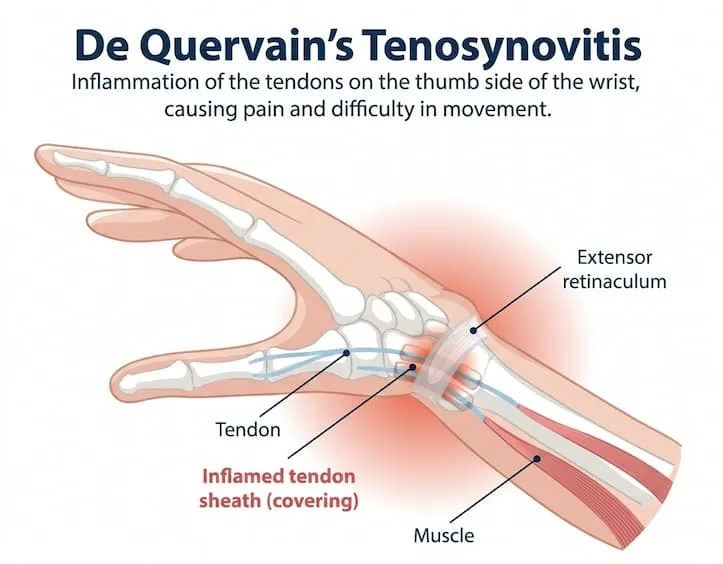
Tenosynovitis refers to inflammation of the tendon sheath, the protective layer that surrounds certain tendons, especially in areas where tendons pass through narrow spaces.
In contrast, tendinitis involves inflammation of the tendon itself. Although the two terms are often used interchangeably, they affect different anatomical structures. This distinction becomes especially important when symptoms are persistent or repeatedly aggravated by daily activities.
A tendon is a strong fibrous tissue that connects muscle to bone and transmits force to produce movement. A tendon sheath is a thin, fluid-filled structure that surrounds some tendons, allowing them to glide smoothly during repetitive motion while minimizing friction. When this gliding system is disrupted, pain and movement limitations can occur—even without direct structural damage to the tendon itself.
The type most commonly affecting the thumb is De Quervain’s tenosynovitis, a condition involving inflammation of the tendon sheath at the base of the thumb. It affects two thumb tendons—the abductor pollicis longus (APL) and extensor pollicis brevis (EPB)—as they pass through a tight sheath near the thumb base. Repetitive actions such as gripping, texting, lifting, or frequent smartphone use can irritate this area, leading to pain, swelling, and difficulty moving the thumb. This is why many cases described as “thumb tendinitis” are actually tenosynovitis, and often require more than rest alone.

Tenosynovitis may improve on its own in some cases, particularly when inflammation is mild and addressed early. However, because the condition involves the tendon sheath, recovery often depends on how effectively friction and repeated irritation are reduced during daily activities. For some individuals, symptoms improve within a few weeks. For others, recovery may take longer if mechanical stress on the tendon continues.
Continued use without adequate rest can maintain or worsen inflammation within the tendon sheath. As swelling increases, the internal space of the sheath becomes more restricted, leading to increased friction during movement.
Over time, this may result in:
Without appropriate management, tenosynovitis can become chronic and recurrent, potentially prolonging recovery time.
Tenosynovitis may require further attention when:
These signs may indicate ongoing mechanical irritation, significant sheath thickening, or the need for additional support and targeted management rather than rest alone.


Copy Link
